
If you lead innovation inside an established B2B company, you already know the validation playbook by heart. Build a quick prototype. Stand up a landing page. Run a smoke test. Watch the signups. Decide whether to keep going. It feels rigorous, it produces numbers, and the numbers go in the steering-committee deck.
And yet a striking number of these experiments end in a shrug. The landing page converts at two percent and nobody can say whether that means the idea is dead or the page was just badly worded. The pilot gets polite interest and no commitment. The team concludes ‘the market isn’t ready,’ quietly shelves the concept, and moves on. That is how established companies kill good ideas, fund bad ones, and pour build budget into the wrong thing. It is the pattern we mapped in the validation gap, where innovation teams burn money on theater.
Here is the uncomfortable part. Most product validation does not fail because the experiment was badly run. It fails because the experiment was testing a vague promise. A clean test of a fuzzy question gives a fuzzy answer every time, so the team gets data but never a decision.
The fix comes from putting two ideas side by side: Alberto Savoia’s pretotyping (from The Right It) and the B2B positioning discipline that Fletch PMM has distilled from over five hundred positioning projects. Read separately, they are a validation method and a marketing method. Read together, they are the same argument, and the second one is what makes the first one work.
And since the whole point of this piece is that you should practise what you preach, I am going to use our own offer, a four-week validation sprint, as the worked example. By the end you will understand both the method and exactly what we sell, because they are the same thing.
This is exactly what our four-week validation sprint is built to fix: sharpen the positioning, find the single riskiest assumption, then run the cheapest real-world test that can decide it, before the build budget is committed. The rest of this article shows you how that works, and why it works.
Key takeaways
- Most inconclusive validation results are a positioning problem, not a demand problem. A clean test of a fuzzy claim always returns a fuzzy answer.
- Pretotyping (Savoia) and B2B positioning (Fletch) say the same thing: measure what customers actually do, relative to what they do today.
- Your real competition is almost never a rival product. It is the status quo: the spreadsheet, the manual process, the ‘we handle it internally.’
- Decide positioning first (who, doing what job, instead of which alternative, persuaded by what differentiated claim), then build the cheapest test against a success bar set in advance.
The same warning from both ends of the product
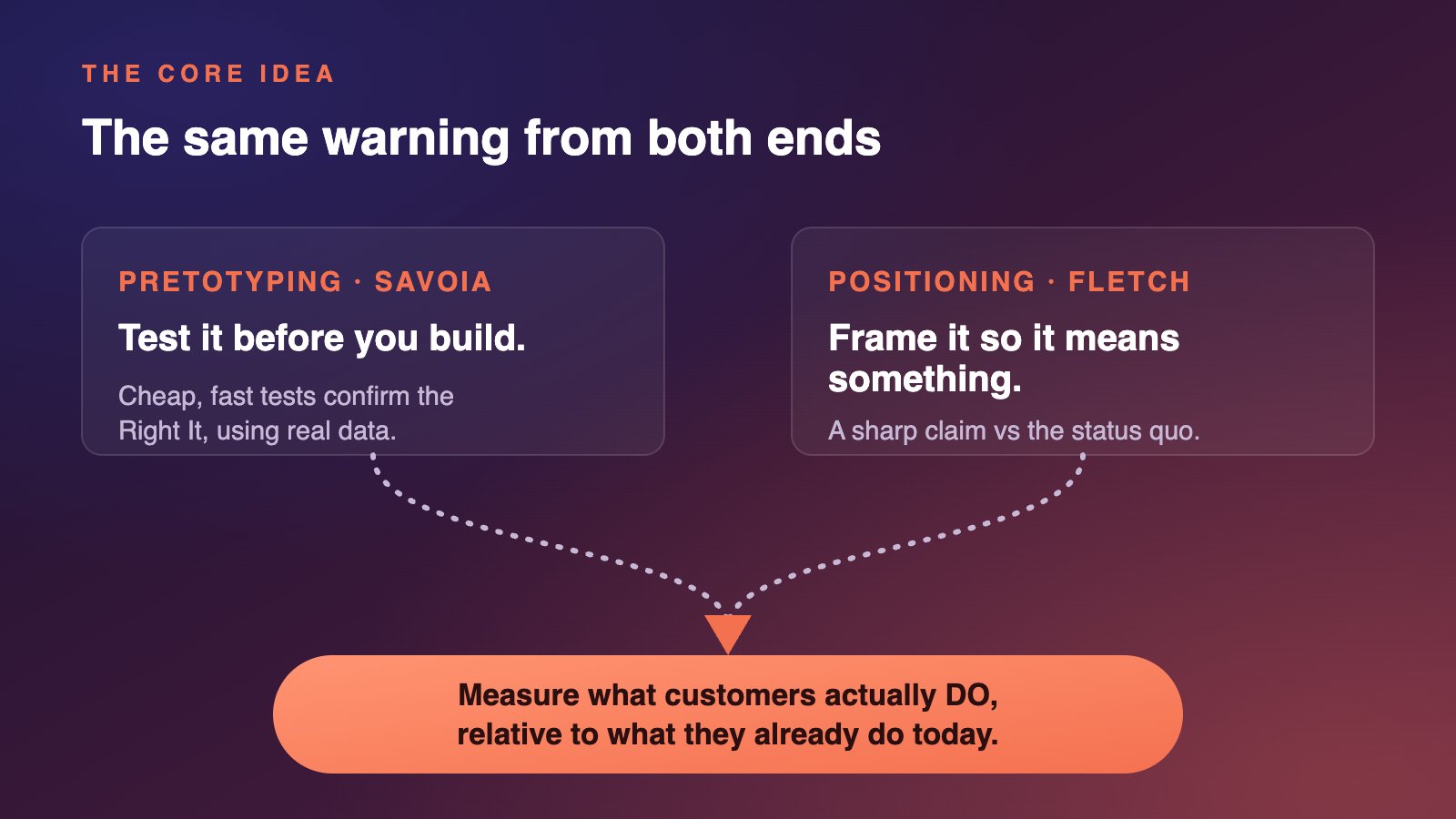
Savoia’s core claim is that most new products fail not because they were built badly but because they were the wrong thing to build in the first place. The cure is pretotyping: before you invest in building It right, run cheap, fast tests to confirm you are building the Right It. The catch is that ideas live in what he calls Thoughtland, the place where everyone has an opinion, every opinion sounds reasonable, and none of it predicts reality. The only thing that counts is your own data, collected from real people doing real things, not saying nice things in a meeting.
Fletch arrives at the same place from the marketing side. Their repeated message is that your real competition is almost never the rival product you are worried about. It is the status quo: the spreadsheet, the manual process, the consultant, the ‘we just handle it internally.’ And the view that matters is never the builder’s view of the market; it is the customer’s. A team that leads with ‘we are the best new-category platform’ is talking to a customer who has never heard of the category and does not care.
Strip both down and they say the same thing: stop trusting your own assumptions and go measure what customers actually do, relative to what they already do today. Savoia tells you to test it before you build. Fletch tells you to frame it so the test means something. For an innovation team inside an established company, that second half is usually the missing, and expensive, piece. (If you want the cheap-test mechanics, we have catalogued three ways to validate ideas without developers.)
Why this bites established B2B companies harder (services companies hardest of all)
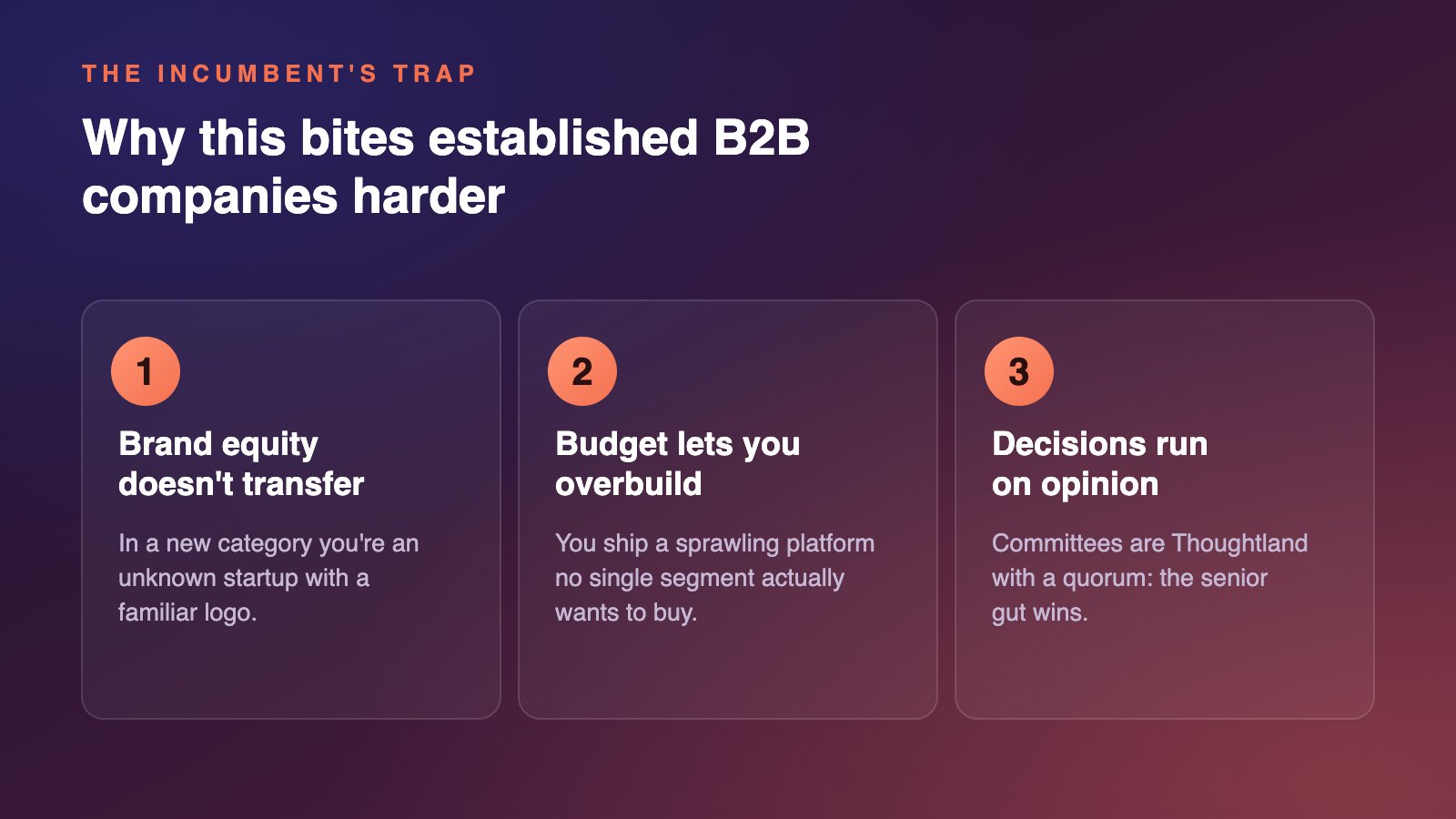
You have an advantage most startups dream of: a trusted brand, real customers, and budget. Whether you are in financial services, healthcare, logistics, manufacturing, or professional services, that advantage quietly works against you in three ways. It bites every established B2B company, and services companies hardest of all, because their brand is built on people rather than product.
Your brand equity doesn’t transfer. Customers trust your core business deeply, and it is tempting to assume the new digital product inherits that trust. It does not. In the new category you are an unknown startup with a familiar logo, and the bigger and vaguer the new platform, the more perceived risk you are asking a buyer to absorb on a promise they have no reason to believe yet. (This is exactly why B2B product branding decisions are a strategic question, not a design afterthought.)
Your budget lets you overbuild. A startup pretotypes because it has no choice. You can afford to build the real thing, so you do, and then you market a sprawling ‘platform’ that no single segment actually wants to buy, because the urge to ship everything ran ahead of the question of whether a market exists for any one piece. It is the same trap behind the 70% failure rate we unpack in the smart, test-first approach to digital transformation.
And your decisions run on opinion. Established companies validate through committees, and committees are Thoughtland with a quorum. The most senior person’s instinct becomes the de facto answer. Savoia’s entire method exists to replace exactly this with evidence that has skin in the game.
So the discipline you most need is not ‘run more experiments.’ It is ‘know precisely what each experiment is testing before you run it.’ That is what positioning gives you, and it is the first thing we do in a sprint, before designing a single test.
Positioning is what turns a smoke test into a real experiment
A pretotype is only as good as the hypothesis underneath it, and a sharp hypothesis needs four things specified. Positioning is the work of specifying them. This is the product validation framework underneath the sprint. Fletch’s framework asks you to nail six components: the market category you are understood within, the target customer (the company, the department, and crucially the champion, the person with internal clout who feels the pain), the use case or job-to-be-done, the competitive alternatives, your differentiated value versus each of those alternatives, and the proof that makes the differentiation believable.
Most teams can list the first four. The two they skip, differentiation and proof, are the whole point. Context describes the stage; differentiation is the actual claim, and it is the claim your experiment exists to test.
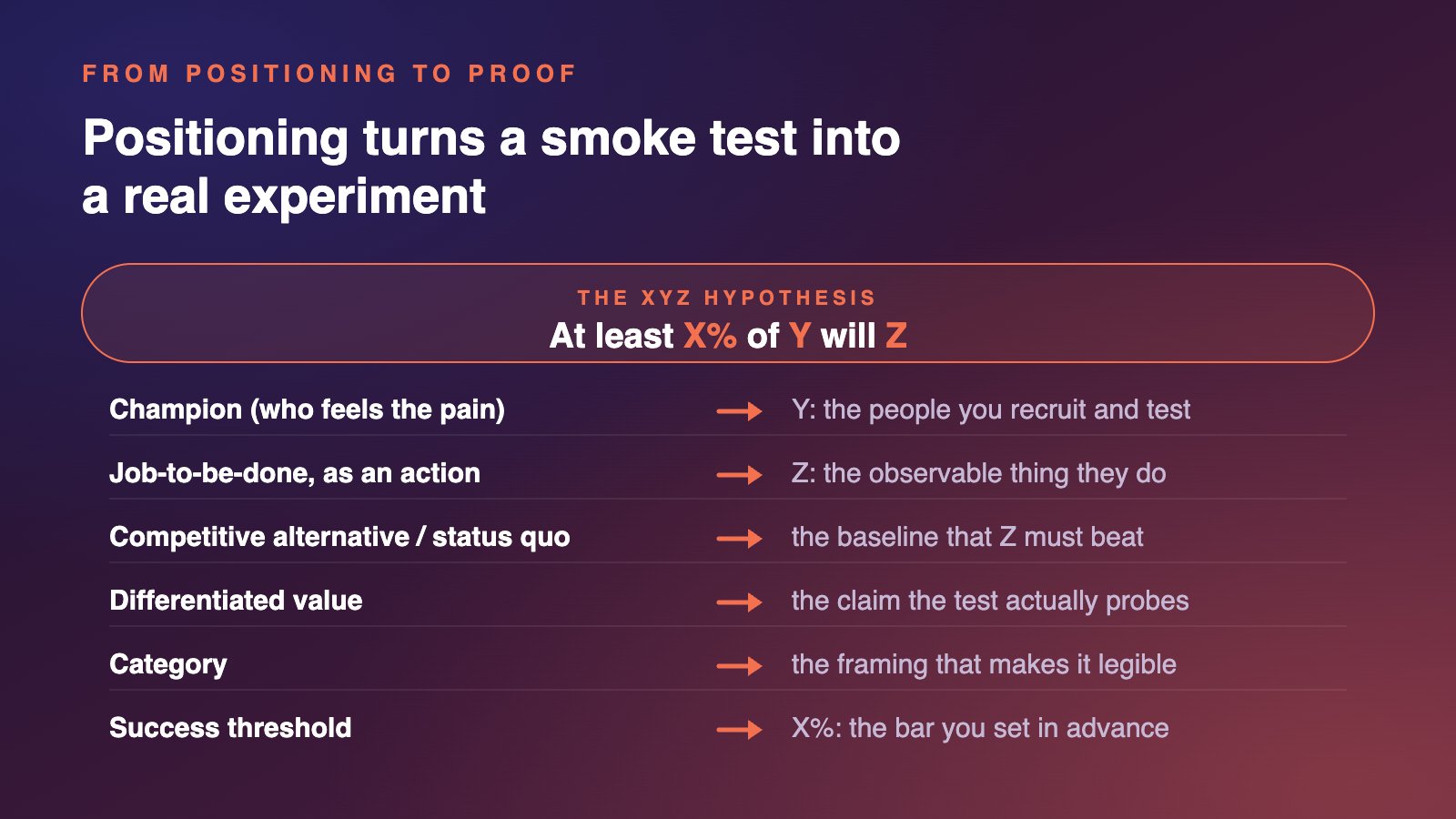
Savoia gives you the container for that claim: the XYZ hypothesis. At least X percent of Y will Z. The components map almost one-to-one.
| Positioning component | Role in the experiment |
|---|---|
| Champion (who feels the pain) | Y: the population you recruit and test |
| Job-to-be-done, turned into an action | Z: the observable thing they do |
| Competitive alternative / status quo | the baseline that Z has to beat |
| Differentiated value | the claim the test is actually probing |
| Category | the framing that makes the offer legible to Y |
| X percent (set in advance) | the bar you commit to before you run |
Two things fall out of this. First, the job-to-be-done is not what you measure; the action is. Savoia insists Z be a behaviour with skin in the game: a booking, a deposit, a signed pilot, not a ‘yes, I’d find that useful.’ Second, differentiation is the variable, which is why muddy positioning produces uninterpretable results. If your landing page test says ‘a modern platform for digital transformation,’ two-percent conversion tells you nothing, because you cannot separate weak demand from a weak description. Make a specific, differentiated claim against a specific alternative and a failure finally becomes interpretable. You have removed the framing confound, so you can ask the right next question: is the demand missing, is the proof too thin, or were the channel and audience wrong? Only then does the number mean what you think it means.
The inception: our offer, run through its own framework
Here is the worked example I promised, our validation sprint, positioned with exactly the discipline above.
- Category: we do not lead with ‘innovation consulting,’ because that is our view, and it sounds like every strategy firm. We lead with the job.
- Target customer / champion: Heads of Innovation and New Ventures inside established B2B companies (services firms most of all) that are going digital, sitting on a new product idea with real build budget about to be committed.
- Job-to-be-done: get a confident go/no-go on that idea before the build budget is spent.
- Alternatives (the real competition): not other agencies. It is (1) just start building and hope, (2) commission a big consultancy to produce a strategy deck, or (3) take the idea through an internal committee and business case. Those are the three default behaviours companies actually innovate with, and the status quo we displace.
- Differentiation, stated against each alternative: versus just building, we get you real demand evidence in weeks, for a fraction of a wasted build. Versus a strategy deck, we return data with skin in the game, not opinion. Versus the internal committee, speed: a decision in four weeks, not four quarters.
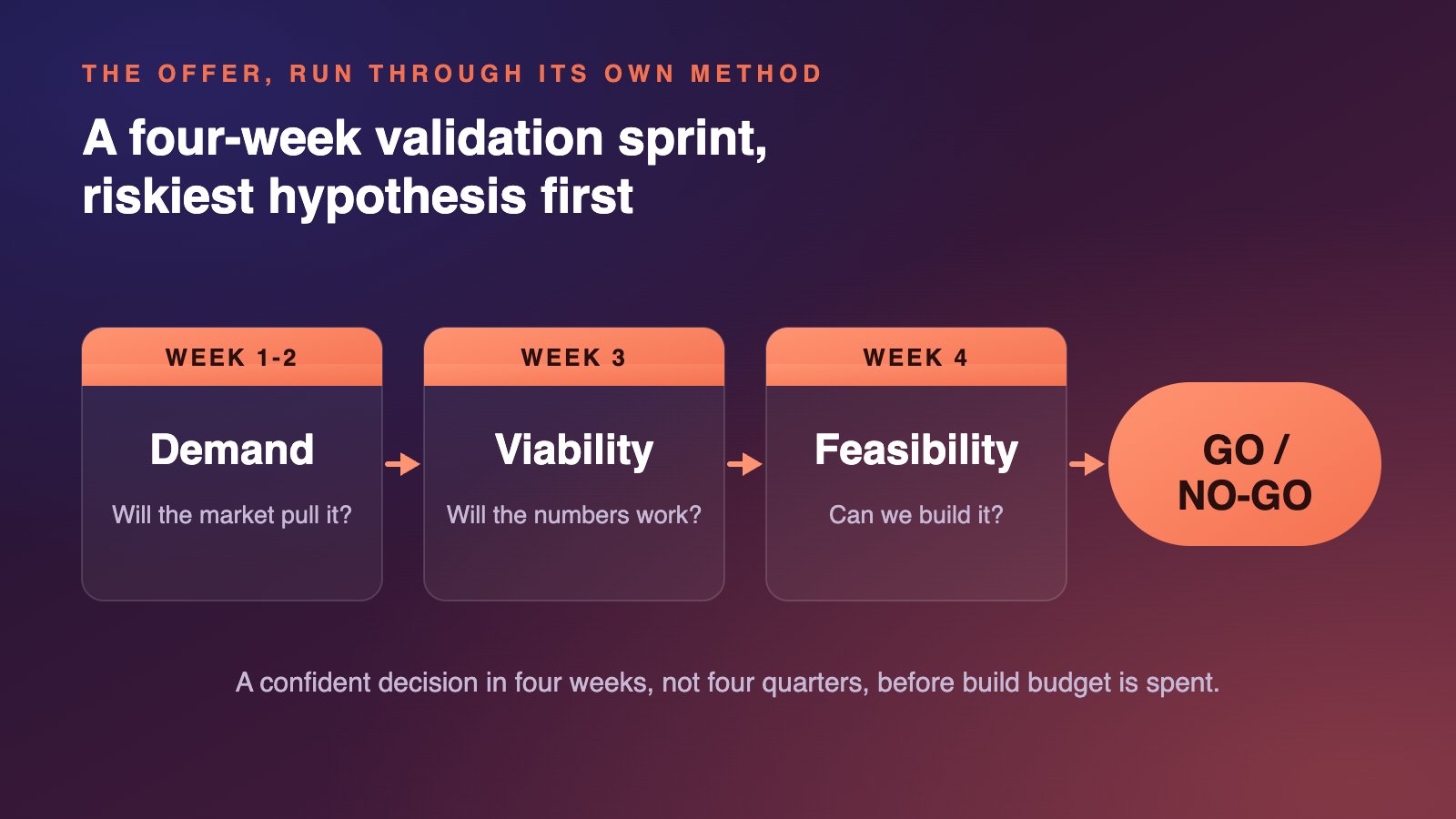
The method itself is the proof: a four-week sprint that runs a sequence of experiments against your riskiest hypothesis first (demand, then viability, then feasibility) so you never spend build money on a product the market will not pull.
What this looks like in practice
In a recent validation sprint for one of our own ventures, the first positioning failed completely: we cold-messaged 96 CTOs and got zero replies, against a hypothesis that at least 5% would respond. The offer was fine. The framing was not. We had led with a category, ‘AI engineering training,’ instead of the pain. When we reframed the problem as ‘AI output has outpaced your team’s ability to review it,’ a single post drew 55 engineers into the conversation before moderators removed it. Same idea, sharper positioning, completely different result. The full teardown, with the real numbers, is in how we productized a coaching service.
You can also see the un-SaaS version of this in the Chiefbase story, where the test was three lead magnets and a WhatsApp number instead of a dashboard.
Now turn the offer into an XYZ hypothesis for the sprint itself:
At least X% of Heads of Innovation at established B2B firms with a new digital product idea and build budget on the line (Y) will book a paid four-week validation sprint (Z), instead of greenlighting the build or commissioning a strategy report (the baseline), when the offer leads with ‘get real demand evidence before you spend build budget’ (the differentiated claim).
And the inception: this article is the top of that funnel. It is our positioning turned into content. If the right Head of Innovation reaches this paragraph thinking ‘that inconclusive-pilot problem is exactly mine,’ then the piece has done its job. It has put a specific champion, a specific job, a specific alternative, and a specific differentiated claim in front of the one person who feels the pain. Which is, of course, the same move we would run as your first experiment.
Why Camplight, and not any competent strategist
The method could be run by any good positioning consultant or product strategist. The difference is where we sit. Camplight is a worker-owned tech cooperative and venture studio that lives between product strategy and product execution. We are not a slide-deck consultancy and we are not a build-first agency. We have shipped hundreds of products, and we have watched teams burn engineering capacity on ideas that were never properly tested. That is the whole reason our validation sprint is designed to make the build / no-build decision sharper before our own engineers ever touch the product.
The move, in one sentence
Decide your positioning first (who specifically, doing what job, instead of which alternative, persuaded by what differentiated claim), then build the cheapest possible test that asks those exact people to take one real action, against a success threshold set in advance. Savoia’s narrowing instinct and Fletch’s ‘pigeonhole yourself’ instinct are the same: one champion, one use case, one alternative, sharp enough that the result is unambiguous.
The teams that keep shelving ideas after inconclusive pilots are not bad at experiments. They are running clean tests of fuzzy questions, and a clean test of a fuzzy question gives a fuzzy answer every time. Position first. Then pretotype. The experiment will finally tell you something you can act on, including, sometimes, the genuinely useful news that the idea was wrong, which is the whole reason you ran it cheaply. That, in the end, is why failing fast is the secret ingredient of venture building.
Pressure-test your product idea before the build budget is spent
Bring us the product idea, the target customer, and the build decision you are about to make. In a short fit call we will help you spot whether your biggest risk is demand, positioning, viability, or feasibility, and what the cheapest experiment to settle it would be. If your next digital product idea is about to get a build budget, talk to us before it does.
Frequently asked questions
What is pretotyping?
Pretotyping is Alberto Savoia’s practice of running cheap, fast tests to confirm you are building the ‘Right It’ before you invest in building it right. Instead of asking people whether they like an idea, you measure whether real people take a real action (a booking, a deposit, a signed pilot) using your own data rather than opinions gathered in a meeting.
Why do landing-page and pilot validation tests come back inconclusive?
Usually because the test measured a fuzzy claim. If a landing page test says ‘a modern platform for digital transformation,’ a low conversion rate cannot tell you whether demand is weak or the description is weak. Sharpen the positioning (a specific champion, one job, one named alternative, one differentiated claim) and the same smoke test becomes interpretable: you can finally ask whether the demand is missing, the proof is too thin, or the channel was wrong.
Should you validate positioning before product demand?
Yes. If the positioning is unclear, your demand validation may measure confusion instead of demand. Before you run a smoke test or pretotype, define who the offer is for, what job it helps them do, which alternative it replaces, and what differentiated claim the test is meant to prove. That is the difference between B2B product validation that produces a decision and a test that produces a debate.
How does positioning relate to Savoia’s XYZ hypothesis?
They map almost one-to-one. The champion becomes Y (who you recruit), the job-to-be-done becomes Z (the observable action), the competitive alternative is the baseline Z must beat, the differentiated value is the claim the test probes, the category is the framing, and X% is the success bar you set before you run. Positioning specifies the variables; the XYZ hypothesis is the container.
What is a four-week validation sprint?
It is a structured sequence of experiments that tests the riskiest assumption first (demand, then viability, then feasibility) so an established company can reach a confident go/no-go decision in four weeks rather than four quarters, before committing build budget to a product the market may not pull.