
Last 14 years in Camplight I’ve been embedded with R&D teams. 1,000+ validation engagements audited. And I see the same pattern, every time.
Ask 10 innovation teams “how do you validate new product ideas?”
You’ll get 10 confident answers.
You’ll watch 9 of them do something else.
Sometimes it’s because of politics, other times it might be just passion blindness. A lot of people want to be seen as busy and hardworking but the real flex is to be successful regardless of the input.
1. What “validation” actually looks like in the wild
I sketched what I’ve seen across 14 years of R&D bets at established companies.
Hundreds of board rooms conversations and looking backwards it fees like this:
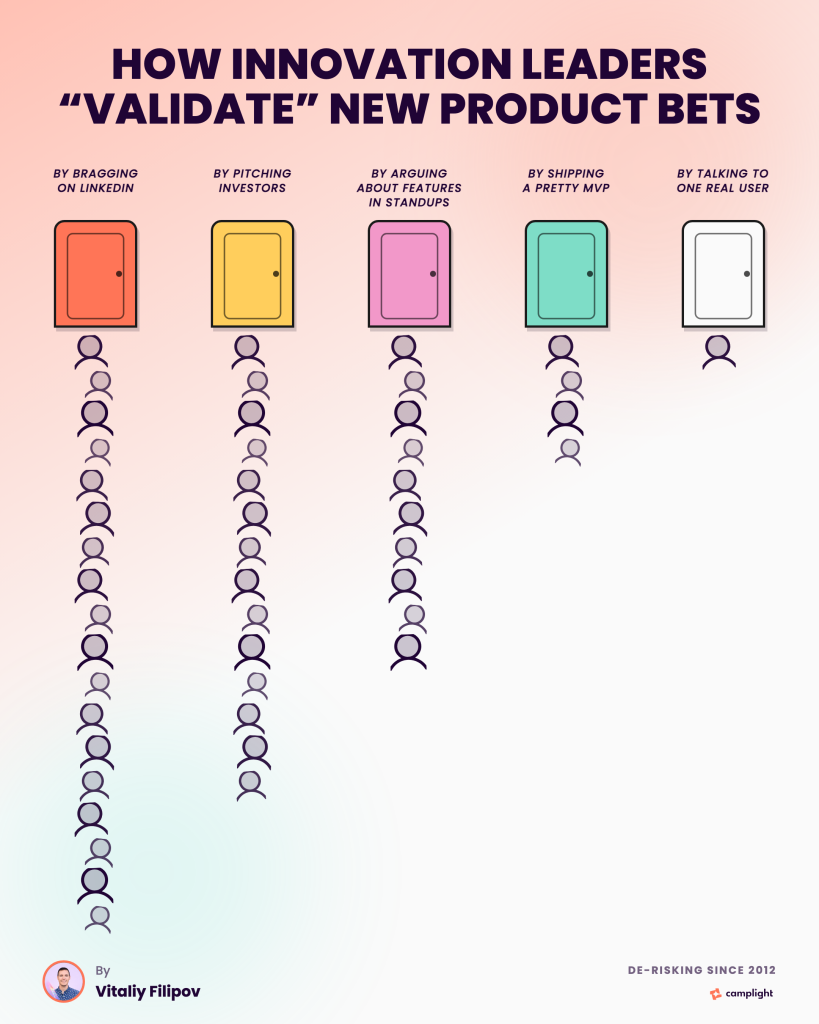
Out of every 12 leaders who claim to validate a new bet:
- 5 brag about it to friends or colleagues on the internet
- 2 pitch it to the board acquiring some job security or social credits
- 2 argue about features in standup as if this will make or break things
- 2 ship a pretty MVP and say they have done their job but with $0 in the bank
- 1 actually talks to a real user and move the needle.
To sum it up: 11 out of 12 never leave their desk.
That’s not validation. That’s everything that looks like validation, ranked by how much you can do without leaving your desk.
The reason this matters for an R&D budget in an established business: 11 of every 12 months get burned on the first four doors. The fifth door is where you’d find out you’re solving the wrong problem in week 2, instead of quarter 4.
And established businesses do not have 12 months to fund what I call corporate theater.
2. Real validation vs. the theater version
So what does the 1 in 12 do? It’s still not enough to leave a desk and seek out the uncomfortable truth of the market reality check.
Three layers, in order.
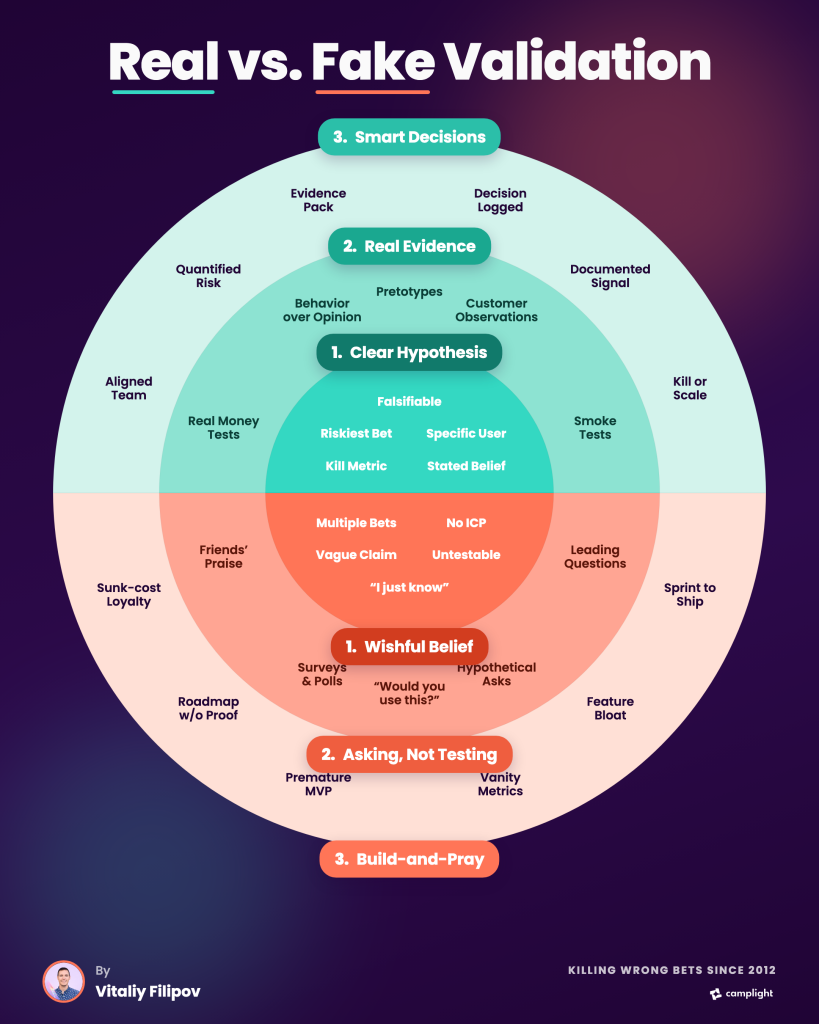
Real validation:
- A clear hypothesis. Falsifiable. Names the riskiest bet. Names a specific user. Has a kill metric written down before the test. If you can’t write this in one sentence, stop. You’re not validating, you’re rationalizing.
- Real evidence. Pretotypes (not a typo!), real-money tests, smoke tests, observed behavior. Things people actualy do, not things they say they will do.
- A smart decision. A documented signal, an evidence pack, a logged kill-or-scale call. If the test runs and nobody decides, it wasn’t validation. It was a workshop.
Fake validation has its own three layers:
- Wishful belief. Multiple unprioritized bets. No ICP. Vague claim. Untestable. The classic “I just know.”
- Asking, not testing. Surveys. Hypothetical asks (“would you use this?”). Leading questions. Anything that lets people lie politely to you.
- Build-and-pray. Premature MVP. Roadmap without proof. Vanity metrics. Feature bloat.
The test that separates everything: can you state, on one slide, what evidence would kill this bet?
If you can’t, you’re in the bottom half of the diagram.
Look – I’m an engineer by heart and know that the biggest dopamine hit is to build a working software and call it a day. But this will not bring clients.
The sad reality is that the build will happen anyway. The kill call will never come because people have overinvested. The fake roadmap will defend itself. Six months after launch, the team will quietly start questioning things. This questioning should start in the beginning, not at the end.
3. What a partner can actually promise
When internal teams cannot deliver, then execs start seeking outside.
This is where most R&D innovation engagements go sideways.
Innovation leaders buy “we’ll validate it” as if validation is a deliverable.
It isn’t.
A validated product isn’t a deliverable. It’s a verdict the market gives you about a test that was run rigorously! Let me try to explain:
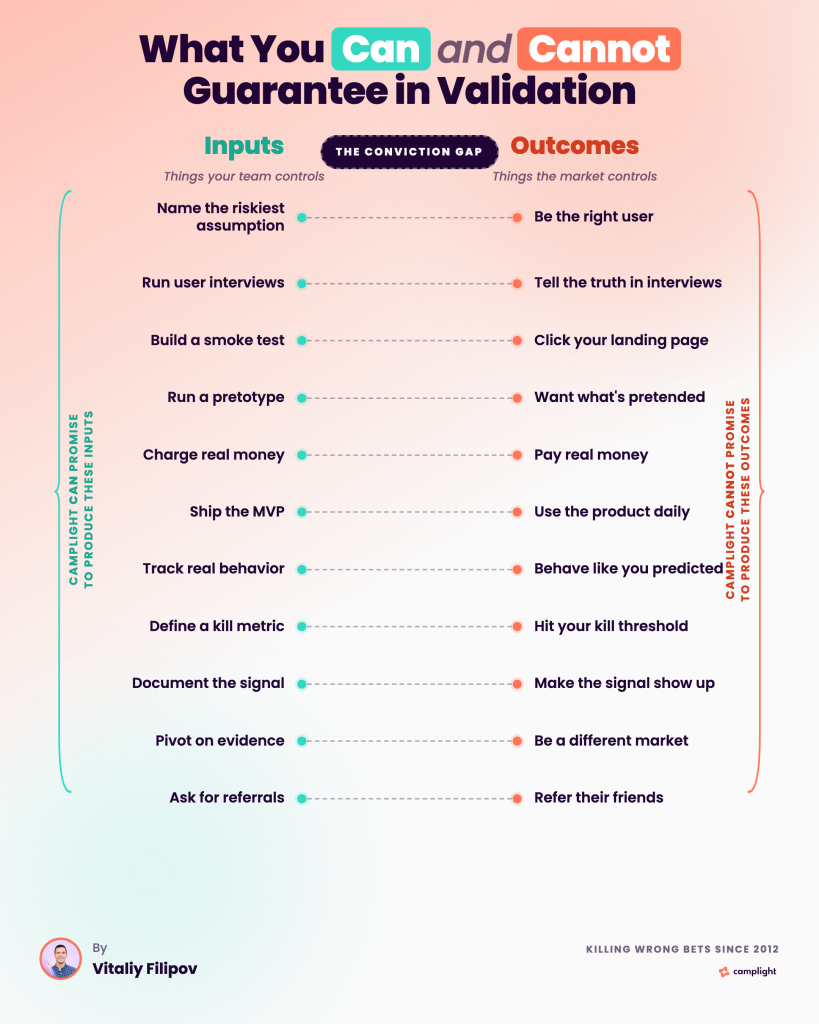
Things your team controls (and a good partner can absolutely promise):
- Name the riskiest assumption
- Run the user interviews
- Build the smoke test
- Ship the MVP after gathering evidence
- Charge real money
- Track real behavior
That’s execution. All of it can be scoped, priced, and shipped.
Things the market controls (and no one can promise):
- Whether the right user shows up
- Whether they tell the truth
- Whether they click your landing page
- Whether they pay
- Whether they refer their friends
This is the conviction gap. If a partner promises you outcomes, run.
My mantra: Conviction is not evidence. Effort is not outcome.
4. The four layers of ROI most teams never collect
But lets say the execs decide to augment their team with a partner. Usually this boils down to what will be the investment and the return.
Here’s the move that separates a one-off “validation sprint” from a compounding validation practice.
Most engagements that do real validation stop at L1. They cash in the obvious savings and miss the next three layers.
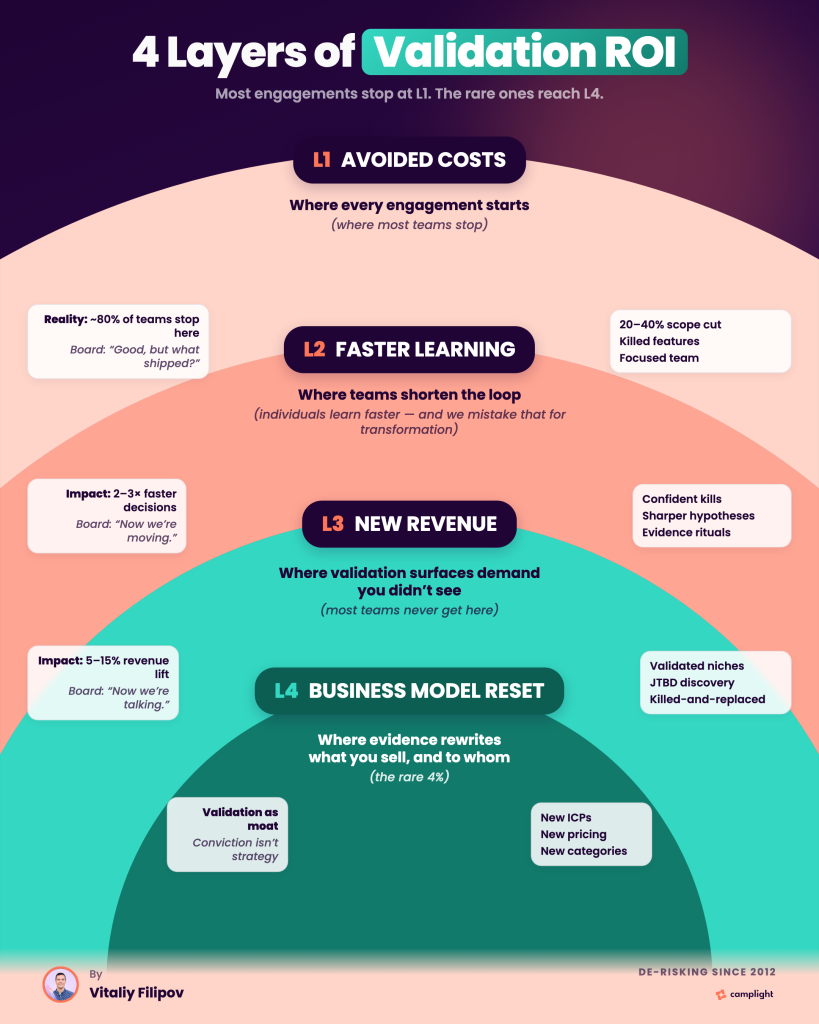
L1, Avoided Costs. The five features you shipped this year that nobody uses? Those would have been 20–40% scope cuts. Killed features. Most teams stop here once they see the savings. The board says: “Good. But what shipped instead?”. Here we are in territory to remove waste and overinvestment
L2, Faster Learning. Decisions made 2–3× faster. Hypotheses sharpen. Kill calls get confident. Evidence becomes a ritual, not a one-off project. The board says: “Now we’re moving.” Our territory here is about finding what we’re underinvesting in.
L3, New Revenue. Validation surfaces demand that you don’t see. Adjacent use cases. Jobs-to-be-done you missed. Niches your competitors haven’t found. 5–15% revenue lift, not from a new product, but from a sharper read of the one you already have.
L4, Business Model Reset. The rare 4%. Evidence rewrites what you sell, who you sell to, and how you price it. New ICPs. New categories. Validation becomes a moat. Your competitors are still running on conviction.
The trick: most engagements stop at L1 because that’s where the savings are obvious and the team is tired. The next three layers are where validation pays back 10×.
A builder will try to counter me by saying: “We ship fast and learn from production”. But this is Level 0. It’s free because of AI, until it isn’t. You can launch even five MVPs a month – but those tokens are going to waste chasing dopamine hits. That’s the most expensive tuition there is.
The takeaway
The validation gap isn’t a skill problem. It’s a staying-at-your-desk problem.
The 1 in 12 leave their desk. They write the kill metric down before the test. They run the test even when the result might be embarrassing. They make the kill call when the evidence says so.
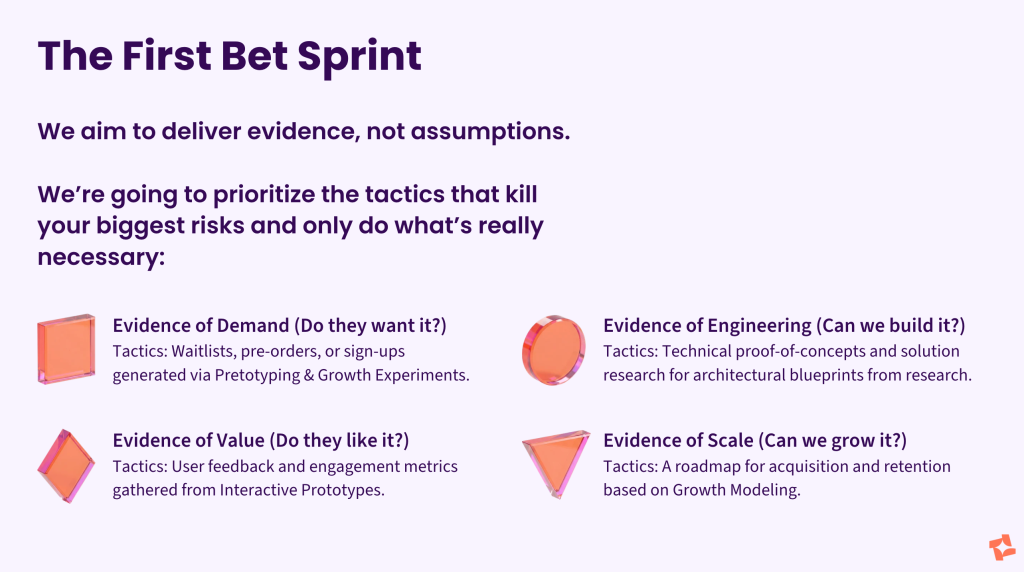
Every innovation needs to test for demand, value, scale or capability. We ran structured first bet sprints because of this and I hope more people start running something similar too.
Here’s an example of our slide decks:
That’s the whole practice.
Everything else is theater.
If you happen to be involved in one, you need to tackle not a skills problem but a mindset issue that might have deep psychological roots.
Turn your R&D budget into validated bets, not expensive guesses.
If you own an R&D budget and want a partner who runs the test that earns a real answer, even when that answer kills the bet, we should talk.