
Most companies are still asking which AI tool to buy. Uber is already asking a harder question: how do you operate thousands of AI-assisted workflows without letting cost, complexity, and risk grow just as quickly?
That is why Uber Engineering’s recent account of its AI Software Factory matters beyond software teams. It is a useful glimpse of what happens when AI stops being a collection of experiments and becomes part of how a company operates.
I break down the four business lessons in the video below. If you prefer the full technical source, read Uber Engineering’s article, Running a Software Factory Efficiently at Uber Scale.
The figures in this article are Uber’s reported figures. Camplight did not build Uber’s system, and we have not independently verified its internal numbers.
What Uber actually showed
Uber says more than 70% of its pull requests are now attributed to local or cloud agents. Its engineers have created more than 3,600 reusable agent skills, with more than 30,000 skill executions per day. From February to August 2026, weekly active users across its agentic tools grew sevenfold and requests grew 9.4 times.
The interesting part is not the volume. It is that Uber reports its total AI spend stabilised while usage kept growing. With one model held constant, it measured a 34% reduction in cost per 1,000 requests from the peak and a 52% reduction in cost per session from its June peak.
Your company is not Uber, and copying Uber’s architecture would be a mistake. But the operating principles travel well. They apply whether you have ten employees or ten thousand.
First: AI has unit economics
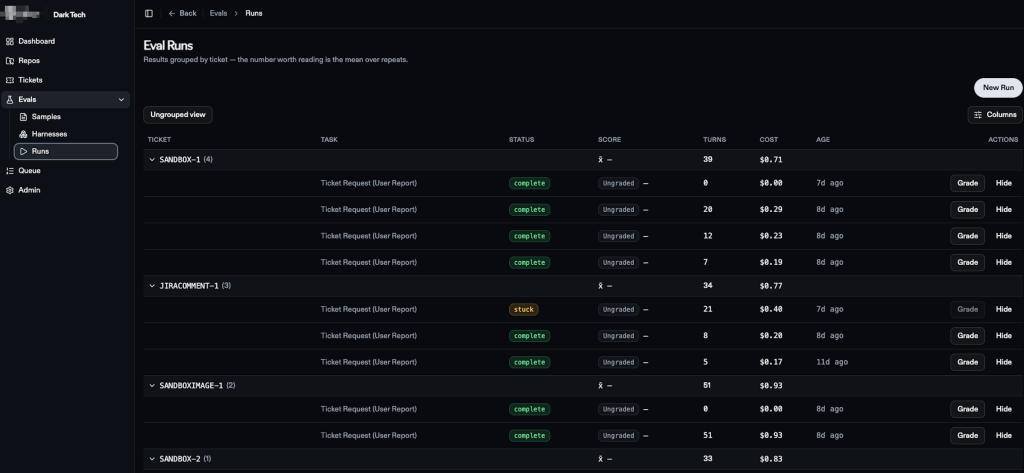
AI spending is often treated as a subscription line: licences in, productivity out. That hides the real economics. Every workflow has a chain of costs: how many people or agents use it, how often they run it, how many turns they take, how many model requests each turn creates, how much context each request carries, and what the chosen model charges.
Those terms multiply. A workflow that retries too often or sends an oversized context on every turn can become expensive even when the model looks cheap. A more capable model can be the economical choice if it finishes reliably in fewer steps. Price per token is not the same as cost per result.
What an SME leader should do: choose a business outcome and calculate the cost per useful completion. For an invoice workflow, that might be cost per correctly processed invoice. For customer support, cost per resolved case that stays resolved. Track failure, correction, and human-review time too. If you cannot name the unit of value, you cannot tell whether the system is improving.
Second: the best AI model is not the best model for every job
There is no universally best model. There is only a model that is good enough for a particular task at an acceptable cost, speed, and failure rate.
Uber describes benchmarking models against real work and moving each managed agent to the option that gives the best balance of quality, reliability, and cost. The main model can break down a difficult task and evaluate the result, while a cheaper specialist handles a narrow, well-defined part.
This is more disciplined than simply downgrading every task to save money. A weak model that creates rework is not cheap. It moves the cost into retries, review, customer frustration, or mistakes.
What an SME leader should do: build a small benchmark from your own work. Use examples with known good outcomes. Compare models on completion quality, total cost, latency, and how often a person has to rescue the process. Route simple extraction or classification to economical models. Reserve expensive reasoning for ambiguity and high-consequence decisions.
Third: company knowledge becomes AI infrastructure
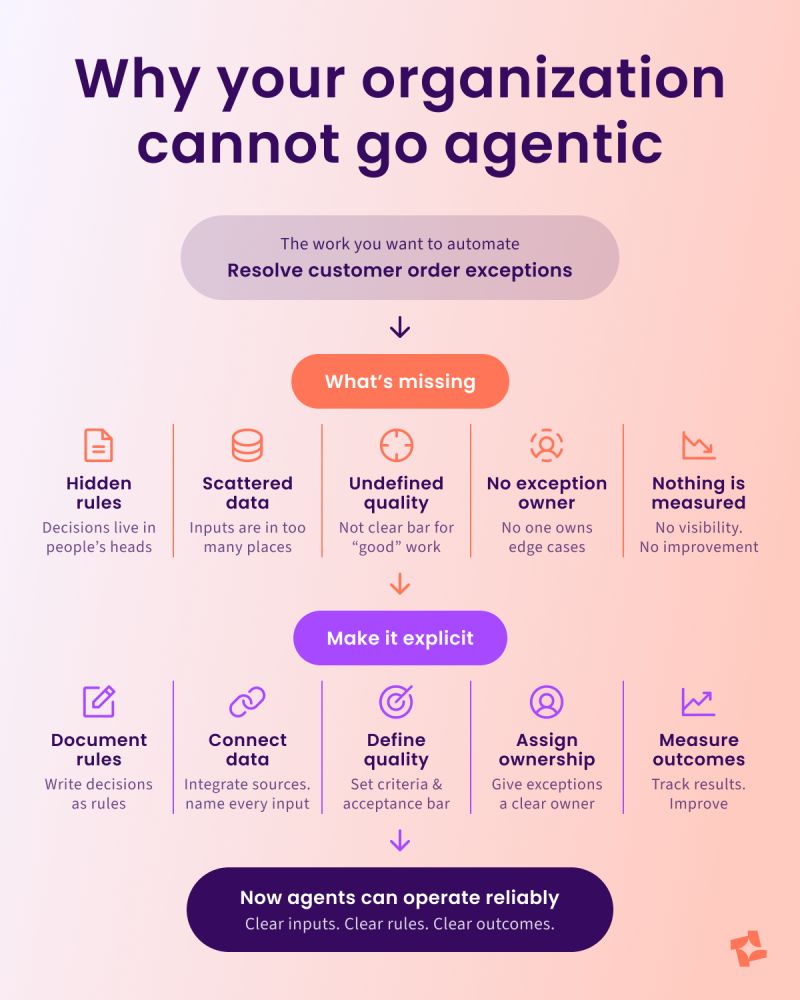
When an employee starts a task, they bring years of context: customer vocabulary, unwritten exceptions, previous decisions, system boundaries, and the reason a process works the way it does. An AI agent starts with none of that unless the company makes it available.
Uber built a large context graph that connects services, teams, incidents, pull requests, design documents, deployments, and data. In one example, Uber reports that a grounded agent found the right answer in 38 seconds, while an ungrounded agent searched for more than 20 minutes and still reached the wrong conclusion.
An SME does not need a graph with millions of nodes. It does need a trusted package of stable context. That can include approved process documents, product rules, customer terminology, escalation policies, data definitions, and decisions that should not be rediscovered on every run.
What an SME leader should do: identify the minimum knowledge required to complete one workflow well. Give each source an owner and a review date. Separate stable guidance from live operational data. Control access, record provenance, and make stale or conflicting instructions visible. More context is not automatically better; trusted context is.
Fourth: company knowledge becomes executable
A process document describes how work should happen. An executable skill packages that knowledge into something an agent can repeatedly perform: gather the right inputs, call the right tools, apply the rules, produce a defined output, and stop or escalate when the conditions are not met.
This is the deeper meaning of Uber’s 3,600-plus skills. The number itself is not a target for smaller companies. The important change is that operational knowledge is no longer only a document people read. Parts of it can become tested, reusable capabilities.
That creates leverage, but it also creates responsibility. Once a rule is executable, a bad rule can be repeated at machine speed. Skills need versioning, permissions, tests, monitoring, and a clear owner. High-impact actions need approval or an explicit escalation path.
What an SME leader should do: start with one routine that already has a clear owner and definition of done. Turn it into a small, inspectable workflow. Keep judgement with a person where the consequences are high or the evidence is incomplete. The goal is not maximum autonomy. It is repeatable work with visible control.
What should business leaders start building now?
A software factory is an operating system for repeatable work. It combines people, agents, models, conventional software, context, review points, and measurement. It is not a chatbot and it is not a pile of AI subscriptions.
- Choose one measurable workflow. Pick a narrow process with a real output, enough repetition to learn from, and an accountable owner. Avoid starting with a company-wide AI transformation.
- Package stable company context. Gather the rules, examples, terminology, constraints, and prior decisions the workflow needs. Name the sources and who keeps them current.
- Route work by capability and cost. Use deterministic software where the rules are known, economical models for narrow tasks, and stronger reasoning only where it changes the outcome.
- Define verification and escalation. Decide what a valid result looks like, what evidence must be retained, when a person reviews it, and what happens when the workflow cannot proceed safely.
- Measure cost per useful outcome. Include model spend, tool calls, retries, corrections, review time, and failures. Improve the system against that measure rather than celebrating activity.
The shift from companies that use AI to companies partially operated by AI is already visible. It should not be confused with removing people. The practical version is supervised: machines handle repeatable execution, while people own the objectives, controls, exceptions, and consequences.
Uber’s scale makes the pattern easy to see. SMEs have an advantage of their own: fewer systems, shorter decision paths, and the ability to prove one workflow before expanding. Start there.
We’re currently building 2 custom-made software factories for our clients and we have one open-sourced.
Turn one AI workflow into a measurable operating advantage
Camplight helps SME teams design, validate, and operate Software Factories around real business outcomes, with costs, controls, and ownership made explicit
We run two audits every month.
Frequently asked questions
What is an AI Software Factory?
It is an operating system for turning business intent into repeatable, verified outcomes. It combines people, AI agents, models, tools, company context, controls, and measurement. It is broader than a coding assistant or chatbot.
Why does model routing matter?
Different tasks need different levels of reasoning, speed, and reliability. Routing lets a company use economical models for narrow work and stronger models for ambiguity or high-consequence decisions, based on benchmarks from real tasks.
What does executable company knowledge mean?
It means packaging approved rules and processes into reusable skills or workflows that an agent can perform. Those capabilities still need owners, permissions, versioning, tests, monitoring, and escalation paths.
How should an SME start?
Choose one narrow workflow with a measurable output. Package the context it needs, match each step to the right tool or model, define verification and escalation, and track the full cost per useful result before expanding.
Camplight is a worker-owned software cooperative founded in 2012. We help B2B teams validate, build, and scale digital products and ventures – from zero to $10M+ ARR. Our validation-first approach has driven a 95% client satisfaction rate across 300+ delivered projects in FinTech, HealthTech, EdTech, and beyond.